Institutional Work
ResearchDataGov
Designing a shared access pathway for restricted federal research data, where one researcher flow had to carry many agency rules.
Product Designer · ICPSR
Client
Federal Government Data Agencies
Role
UX Designer
Timeline
8 months
Track
Institutional Work
Signature Artifact
Agency access matrix
The page opens with the structure of the service problem: one researcher journey had to carry dataset rules, agency rules, review logic, and provisioning states.
Restricted data access model
One path, many rule systems
The Breakpoint
Researchers needed one path
through many agency rules.
ResearchDataGov supports access to restricted federal research data. The difficult part was not only helping researchers find datasets. It was designing a service that could carry different agency requirements, dataset rules, required documents, review periods, and provisioning paths without making the application feel like a maze.
My Role
ResearchDataGov
Lead product design for the restricted data access experience, including application requirements, dataset selection, applicant workflows, reviewer workflows, and design specifications for engineering handoff.
Context
ResearchDataGov brought several services into one access pathway: metadata ingest, public data discovery, dataset selection, restricted access applications, reviewer determination, notifications, reporting, and production support. Each service touched a different group: data owners, applicants, reviewers, administrators, and support teams.
Approach
I treated the product as a shared service architecture rather than a set of isolated screens. The core design work was mapping how a researcher moves from discovery to selection to application, while keeping agency-specific requirements visible only when they matter. That meant designing for progressive disclosure, versioned required documents, dataset-based review rules, and clear status changes across applicant and reviewer views.
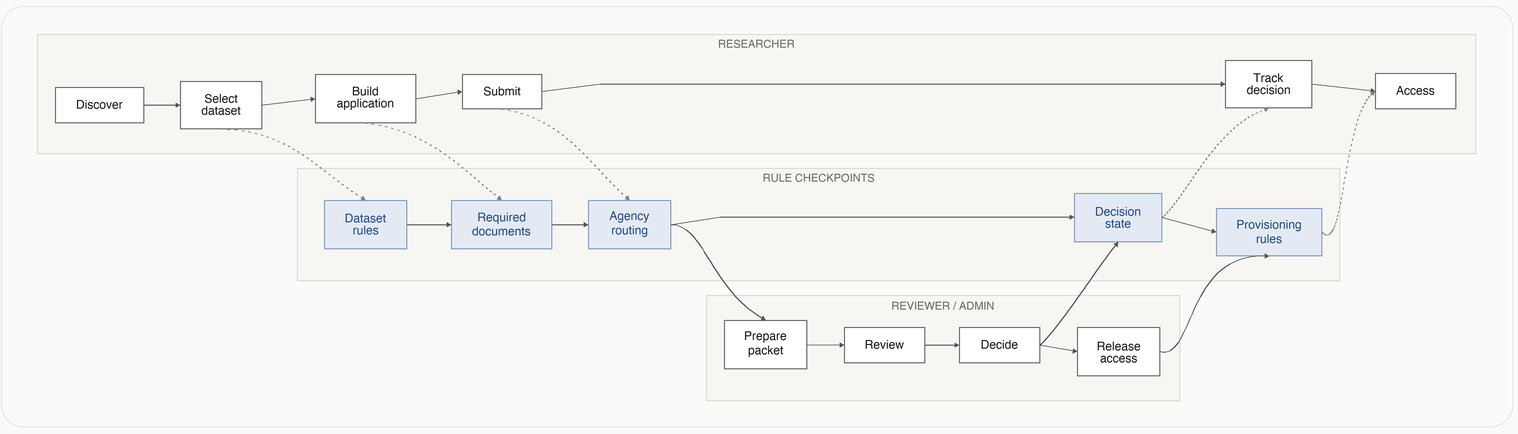
A shared access path connecting researcher actions, dataset- and agency-specific rule checkpoints, and reviewer handoffs.
Design Focus
One Flow
Unified discovery, dataset selection, application, review, and provisioning into one end-to-end access path.
Many Rules
Supported agency- and dataset-specific requirements without exposing every rule at once.
Two Sides
Connected applicant and reviewer experiences around the same application data and status logic.